




First, get the timeline right
Exa's name change from Metaphor was announced on 25 January 2024. HEX's portfolio dates its Exa entry to 12 May 2025. The earlier Brand Recall review date in August 2026 is not evidence of an August identity launch. Treating all three dates as one event would make an established system look newly released and erase the very continuity this publication wants to examine. E04 E02
The current homepage positions Exa around data for AI agents, with search, content, agent and monitoring products. It reports 500,000 developers; that is a company claim with no independently established active-user denominator in this research. It tells us the intended reach of the platform, not whether people recognise or remember its identity. E05
These dates and surfaces create a better review question than whether the rebrand looks good: can a relatively stable visual idea explain a business whose interfaces and audiences are changing?
The design argument
HEX frames its work through knowledge, Greek references and technical precision, and lists identity, guidelines, decks, social applications, illustration, subbrands and website work among the deliverables. That establishes the agency's declared scope. It does not independently prove adoption or consistency in every channel. E01
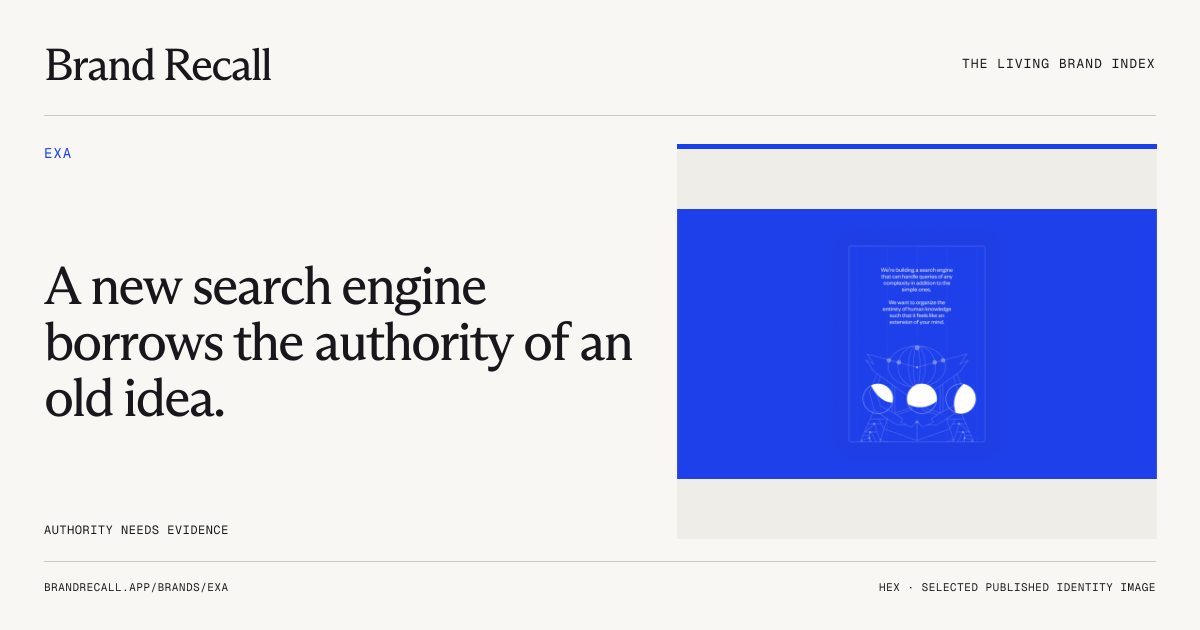
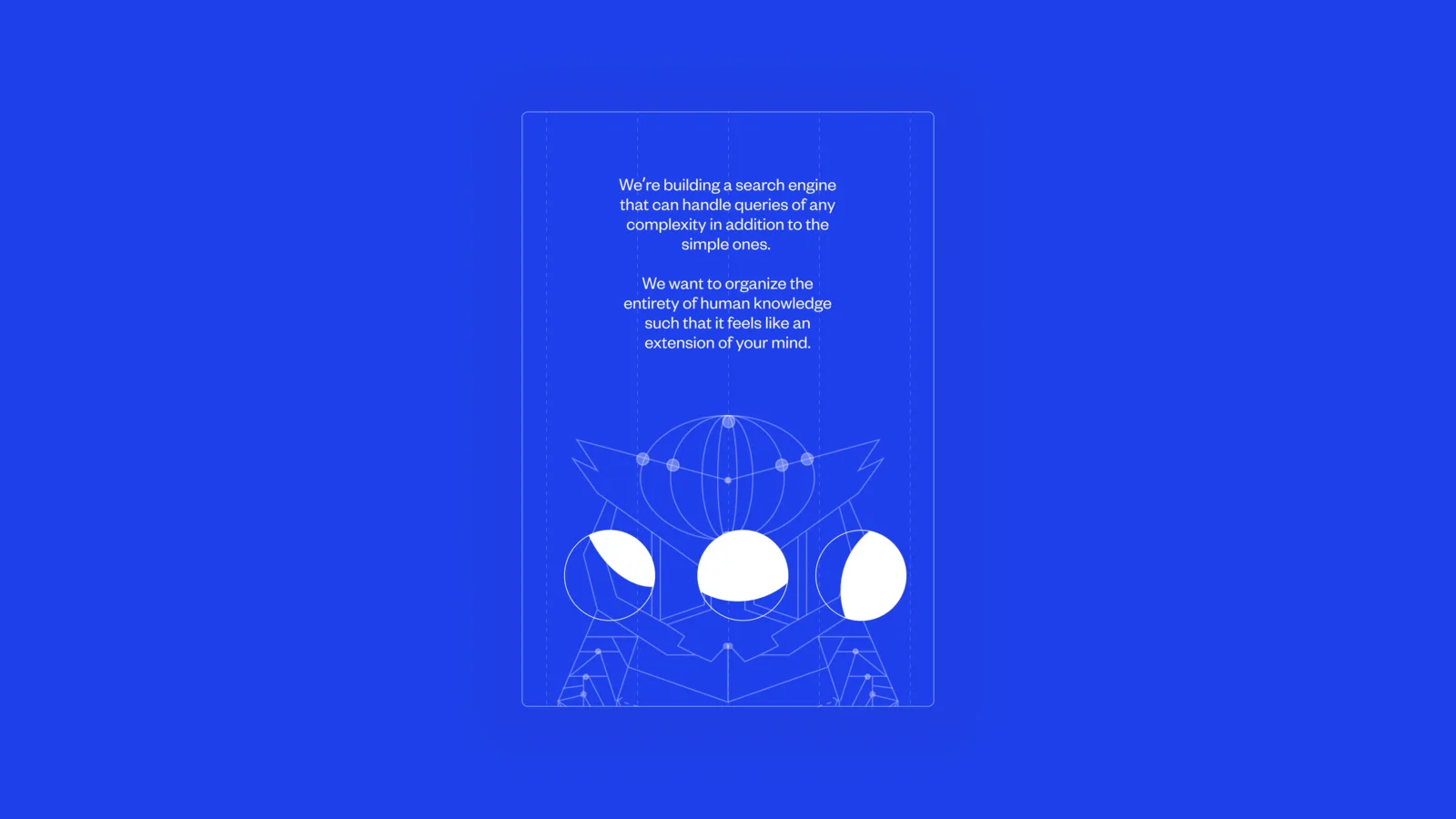
The inspected blue composition uses fine white construction lines and orbital geometry around a small typographic centre. Our reading is that the empty space performs an important role: it makes the system appear deliberate rather than crowded by its own technical symbolism. The geometry offers a sense of order without needing to represent a literal search result. E01
That strategy has a tension. References to accumulated knowledge can give a young service seriousness, but seriousness is not the same as trustworthiness. A polished scientific atmosphere can make an assertion feel established before the evidence has earned it. The identity is strongest when the accompanying communication is equally precise about what the product can and cannot do.
Exa's official brand page identifies an hourglass mark, signature blue, white and a marble neutral, alongside ABC Arizona Flare and ABC Diatype. The page provides concrete elements that others can retrieve. It is stronger evidence of an addressable kit than a portfolio image alone. It does not demonstrate that the kit contains every decision needed to make unfamiliar work. E03
The serif and the technical structure create a potentially useful division of labour: one suggests a human tradition of enquiry; the other suggests organised retrieval. That is our interpretation, rather than a measured association. The combination needs to be judged against neighbouring search and AI identities, because blue, grids and intellectual imagery are not exclusive ingredients.
Four places to look
Hero. The identity gives Exa a composed point of view. It avoids having to make every new capability announce itself through a completely different aesthetic. The challenge is ensuring the formal language helps explain the proposition rather than merely decorating an abstract promise.
Habit. The documentation offers Python, JavaScript and cURL entry paths. Here, the brand's most important expression may be the quality of explanation: can a developer understand the first request, the shape of the response and the limits of the service? This review inspected the public documentation structure; it did not run code or certify accuracy. E06
Friction. Exa publishes an evaluation index and a methodological explanation that describes query sets and grading choices. These are provider-authored performance materials, not independent findings. Their value to a brand review is that they give broad claims something inspectable to sit beside. A capability claim becomes more credible when its conditions are visible. The published use of model grading must not be mistaken for human brand recall research. E08 E09
Handoff. The public kit makes official assets findable. The next test would ask an unfamiliar operator to build a tightly specified application from that kit, without access to the original team. We would inspect what the operator gets right, where they improvise and whether the resulting choices remain recognisably Exa.
The craft judgement
Execution: controlled in the inspected identity work. The relationship between type, space and geometric detail is persuasive. That judgement has a narrower evidential base than a complete production audit; generated error states, product screens and accessibility behaviour remain incompletely sampled.
Distinctiveness: credible as a combination, untested as recognition. The structure and typographic character are more interesting together than any single ingredient. A comparative test should remove names and expose participants to equivalent material before claiming that the system is unmistakable.
Fit: strongest where intellectual confidence meets explicit proof. A knowledge service can reasonably adopt a serious visual language. The fit weakens if the language implies certainty that the product copy or evidence cannot support. This is a relationship to examine, not an accusation that the product fails.
Range: documented across formats, not yet independently reproduced. The agency's declared applications and public kit support a broader system than one launch page. There is still a difference between a list of deliverables and evidence that different teams can extend them successfully.
A brand for people choosing tools for machines
Exa's audience creates a useful distinction for Brand Recall. People may encounter its website, documentation and developer communications; an agent may interact with a structured interface. Those are different kinds of continuity. An API that returns valid data does not, by itself, prove brand memory. A memorable website does not establish dependable machine use.
Our Memory reading therefore remains bounded. Recall has no registered human study. Rebuild has a public kit but no independent reconstruction result. Respond has a family of proposed applications but no held-out evaluation. Renew has a traceable chronology, yet a proper continuity study would need comparable dated examples and a clear account of what was intentionally retained.
This is where the review could become more useful over time: maintain the same questions while adding real examples as the product changes. A newly launched feature should not reset the entire judgement, nor should an old, successful identity be rewarded merely for surviving on a website.
The counter-reading
The academic world may be too readily available as a shorthand for intelligent technology. If a viewer remembers “a tasteful blue AI company” but cannot identify Exa, the visual atmosphere has travelled further than the brand. Conversely, a developer might remember Exa through an exceptionally useful example or reliable explanation rather than through the mark. A serious assessment needs room for both outcomes.
What would change this review
We would revise the distinctiveness finding after a matched comparison that separates category recognition from Exa recognition. We would strengthen the handoff finding after seeing independent applications and their evaluation. A dated before-and-after set across product, documentation and communications would sharpen the continuity reading. Evidence that important claims are routinely qualified in ordinary use would strengthen the relationship between visual authority and editorial precision.
Questions for Exa and HEX
- Which parts of the 2024 naming story, the 2025 identity and today's product presentation belong to separate decisions?
- Which cues must survive when a format cannot support the full visual system?
- Where did the academic references help users understand the product, and where did you reduce them?
- What changed between the original handoff and applications made by Exa's own team?
- Can you share a rejected application and explain the judgement behind its rejection?
- What audience evidence distinguishes familiarity with the category from recognition of Exa?