




Two stories that should not be collapsed
Paul Jun's 21 August announcement names the evolving Ramp system Solar System. He describes a software-like approach to brand, prioritising coherence as the company changes, and reports a four-week first version. The post names a broad group of collaborators. This is an account from a maker about intent and production, not proof that every claimed operational benefit has occurred. R04
Offgrid's same-day post corroborates its involvement in the refresh and lists collaborators. Its portfolio separately lists Ramp Stack identity work in 2026. Those sources support attribution at a workstream level; they do not assign every texture, tool or application to one author. R05 R03
Stack itself was announced on 3 June as an AI accounting platform. That precedes the August announcement. A review that treats Stack's launch material as if it were all created for Solar System would obscure chronology and overstate our understanding of the system's evolution. R01
The stronger framing is a brand in motion, with named episodes and distinct evidence. We can ask how each episode relates to the parent without pretending we have seen a complete internal history.
What the visible work suggests
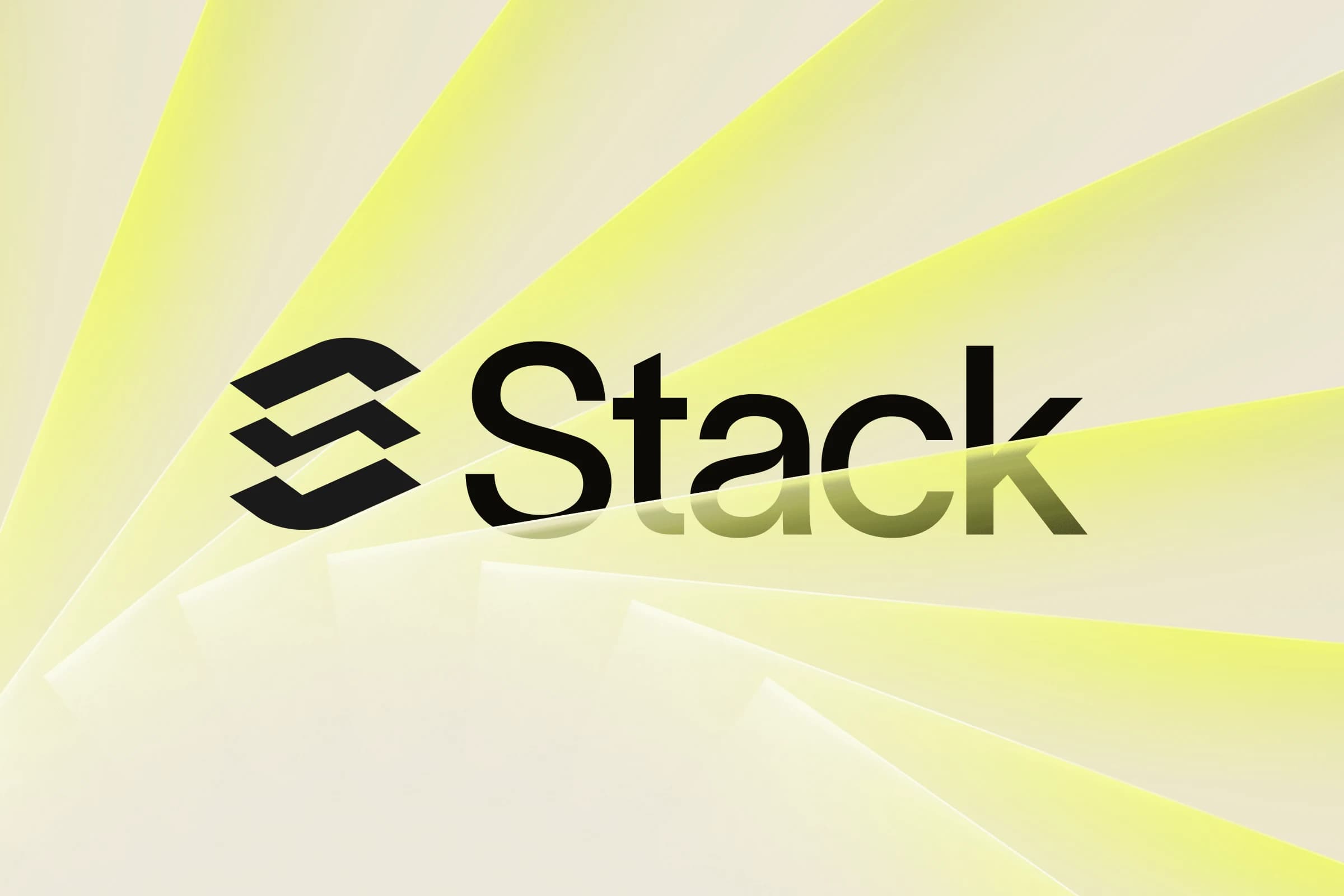
The inspected Stack collage places a dark wordmark and layered symbol against pale cream and citron forms. Folded planes make the idea of a stack tangible. Our reading is that the material quality offers a useful counterpoint to an abstract AI product: a structure that can be assembled, handled and understood. This interpretation applies to the Stack image, not to unseen parts of Solar System. R03
The danger is literalness. Layers can explain the name while saying little about the service's particular value. Their usefulness depends on how they combine with language, product structure and repeated behaviour. A compelling visual metaphor still needs a rule for when to appear, how far to vary and when to step aside.
Ramp's broader proposition raises a related question. Coherence is a more demanding ambition than sameness because it requires judgement. If every output can differ, the system must explain which differences matter. A team needs to be able to reject something that uses the right colour and still feels wrong. The public philosophy is a good beginning; examples of those decisions would make it substantially more credible.
The product supplies a useful parallel
The Stack launch describes firm-specific skills, rules and workpapers, and reports that Ramp serves more than 4,500 accounting firms, including 92 of the largest 100. Those are company-reported commercial figures. They establish an intended professional context; they do not establish the quality of the identity or the performance of the AI. R01
Another launch account describes more than 20 early design partners and says feedback shaped formula-based workpapers and firm-level permissions. This is a concrete provider account of product learning, although the selection of partners and outcomes is controlled by Ramp. It does not independently demonstrate brand-system learning. R02
The parallel is still productive. Both accounting workflows and flexible identities need constraints, decisions and a record of why something changed. The review should ask whether the brand system has an equivalent mechanism: what was proposed, what was accepted, what was rejected and what future work should now do differently?
Four places to look
Hero. Stack's material language makes an intangible proposition easier to picture. The Solar System announcement supplies an operating ambition. The two forms of evidence are complementary, but they are not interchangeable.
Habit. Ordinary finance and accounting interactions need precision, readable numbers and dependable hierarchy. Their success may look visually restrained. We have not inspected a representative authenticated product corpus, so this remains an explicit coverage gap rather than an assumed strength or weakness.
Friction. The public Stack enquiry form distinguishes accounting firms from in-house teams and asks for context including firm information and client volume. This is a small but inspectable transition from brand promise to qualification. The form was observed, not submitted. The review cannot infer what onboarding or implementation feels like from this entry point. R06
Handoff. The public statements suggest a system intended to keep evolving. No internal tooling or unfamiliar-team output was supplied. An operating philosophy becomes evidence of transferable craft only when we can inspect what another maker does with it and how the result is judged.
The craft judgement
Execution: promising in the inspected Stack composition; broader coverage remains partial. The physical metaphor is legible and the contrast is controlled. A whole-brand verdict needs a larger, correctly attributed set of ordinary applications.
Distinctiveness: a combination to test. Citron, dark type and layered structures can form a useful family, but none alone proves recognition. The open question is whether someone identifies Ramp across very different outputs, rather than merely recognising a contemporary finance aesthetic.
Fit: a strong operational ambition. A fast-moving product organisation has a credible reason to build a flexible identity. Speed of production is not sufficient justification by itself. The system should improve appropriateness and understanding as well as output volume.
Range: asserted, illustrated and still incompletely demonstrated. Named launches show multiple contexts. Public maker statements establish intent. We need examples produced by different people, under different constraints, to judge how reliably the system extends. The most revealing evidence may be the cases that did not pass review.
Memory requires more than a generative story
Recall needs people, controlled exposure and competing alternatives. Rebuild needs an operator who did not create the original system. Respond needs a new situation whose answer was not already baked into the kit. Renew needs comparable work across time and a record of intentional changes. None of these can be inferred from a large gallery or a fast production schedule.
A generator could make thousands of outputs while leaving the same small set of design decisions unresolved. Conversely, a modest kit could transfer a distinctive idea very effectively. Brand Recall should reward observed capability, not the sophistication of the tool's description.
The counter-reading
“Brand as software” may become a persuasive metaphor that conceals the continuing importance of a few highly skilled people. If the system depends on those people reviewing every important output, that does not make the work bad. It changes the claim. It is evidence of a strong team, not necessarily an independently operable brand system.
The right test should therefore record assistance. A reconstruction made with unlimited direction from the original creative lead cannot be compared with one made from a documented kit alone. Both can teach us something, provided their conditions remain visible.
What would change this review
A dated map connecting Stack, Solar System and later applications would sharpen the scope. A demonstration of the tools, followed by work from an unfamiliar team, would strengthen the handoff finding. Examples of decisions that protected coherence while changing appearance would make the philosophy concrete. A recognition study could reveal which cues survive variation and which are primarily meaningful to the makers.
Questions for Ramp and Offgrid
- How do Stack's June identity and the August Solar System relate, and which assets belong to each?
- What must remain true across outputs even when their appearance changes substantially?
- Which production decisions are encoded in tools, and which depend on editorial judgement?
- Can you show an attractive output that was rejected, with the reason and resulting rule?
- What has a team outside the original group made successfully, and how much assistance did it need?
- What evidence shows that increased variation preserves recognition and improves understanding?